Friday 4/24/26 Bill Meyer Show Guests and Information
Podcasts on www.BillMeyerShow.com
Facebook – www.Facebook.com/billmeyershow
6:35 Dennis Kneale, best-selling author https://denniskneale.com/ and acclaimed journalist, is the author of the forthcoming “Ore-Goners.” He previously anchored at CNBC and Fox Business after senior roles at The Wall Street Journal and Forbes. Dennis left NYC after 40 years when Mamdani got in office.
ABOUT BOOK: Ore-Goners is a powerful, data-driven examination of Oregon’s economic and social unraveling—offering both a clear blueprint for reversing course and a timely warning for other states headed down the same path.. Blending statewide polling, on-the-ground reporting, and historical context, the book traces how rising costs, heavy regulation, public-safety failures, and ideological extremism pushed a once-thriving state to the edge.
At the heart of the story is the growing divide between everyday Oregonians and the political decisions shaping their lives. From Portland’s prolonged controversies—such as clashes surrounding the protection of federal facilities—to statewide debates over business restrictions, taxation, and public order, Ore-Goners shows how a series of escalating decisions triggered widespread backlash.
As high-income earners depart and Oregon suffers billions in lost taxable income, the state now has the second-highest income-tax rate in the nation, behind New York. Despite spending more than $700 million on homelessness, conditions continue to worsen, fueling what many see as a “homelessness industrial complex” with little visible improvement on the streets.
Ore-Goners is not simply a warning it is a call to action.
BIO: Dennis Kneale, author of the upcoming book “Ore-Goners,” is an award-winning journalist, media strategist, advisor to senior executives, and host of the What’s Bugging Me podcast on the Ricochet network.
7:10 Greg Roberts, Mr. Outdoors from www.RogueWeather.com has a recap of the wolf meeting in Butte Falls from last night.
8:10 Daniel Greenfield, CEO at the David Horowitz Freedom Center, and author for frontpagemag.com – www.danielgreenfield.org
Daniel is the author of Domestic Enemies: The Founding Fathers’ Fight Against the Left
Swalwell May Be Replaced by First Afghan Muslim Congresswoman
By Daniel Greenfield, CEO of the David Horowitz Freedom Center
…whose treatment of women is even worse than Swalwell’s.
Who will replace former Rep. Eric Swalwell? It won’t be some white guy. Here’s the list of candidates. Aisha Wahab, an Afghan Muslim, appears to have the inside track and is holding the process ‘hostage.’ State Sen. Aisha Wahab’s gender politics though make Swalwell look like a feminist. [more…]
______________________________________________________________
Thursday 4/23/26 Bill Meyer Show Guests and Information
Podcasts on www.BillMeyerShow.com
Facebook – www.Facebook.com/billmeyershow
6:35 Kent Hickenlively JD is a California attorney and author of 20 books on government corruption. Catastrophic Disclosure (Post Hill Press) argues this entire UFO/UAP rollout is staged, a managed reveal to sell UAPs as a threat and justify the next defense buildup. Every missed deadline and on-script whistleblower fits the pattern.
Spielberg’s Disclosure Day drops June 12. He told CinemaCon it’s ‘more truth than fiction.’
Kent Heckenlively and Michael Mazzola’s book opens with the thesis that Hollywood has been part of the UFO cover-up since 1947. Chapter one is literally called ‘Nukes, UFOs, and Hollywood: The Trinity of American Power.’ They argued this in print last November. Spielberg’s own words now prove it. And the news is catching up fast:
– Trump promises UFO documents ‘very soon’ at Turning Point last Friday
– Hegseth blows Luna’s April 14 deadline on 46 UAP videos
– Burchett tells NewsNation Americans would be ‘alarmed’
– AARO admits over 2,000 open cases
7:35 Sarah Young, executive director of the prescription drug affordability board, and Jason Horton Public information officer, Division of Financial Regulation, Department of Consumer and Business Services
The Oregon Prescription Drug Affordability Board (PDAB) is hosting a series of community forums April 28 to May 20 to hear from people about the high cost of prescription drugs and the effect it has on their lives and budgets.
The online forums are scheduled for April 28, May 11, May 13, with the online board meeting on May 20. In-person forums will be held in Salem, Redmond, Portland, and Beaverton.
“We invite all Oregonians to join us at these forums and share your stories about the cost of your medications and how those costs impact your lives,” said Sarah Young, PDAB executive director. “All forums will have similar content, so choose the best option for your schedule. We would love to have patients, caregivers, and consumers join us to share their experiences. Hearing your stories will help inform the board as it reviews drugs to identify affordability challenges and high out-of-pocket costs for patients.”
The board conducts annual drug reviews and presents a list of medications that may create affordability challenges to the Oregon Legislature each year. This year, PDAB will review the following medications to evaluate their affordability and their impact on Oregonians and the state’s health care system:
- Jardiance, Mounjaro, and Ozempic (Type 2 diabetes)
- Humulin R U-500 (improve blood sugar control for those with Type 1 and Type 2 diabetes who require more than 200 units of insulin per day)
- Keytruda and Verzenio (cancer)
- Xeljanz (autoimmune and inflammatory conditions)
- Ocrevus (multiple sclerosis)
- Skyrizi (immune-mediated inflammatory conditions)
- Tremfya (plaque psoriasis)
- Xolair (allergic and inflammatory conditions)
The feedback from the community forums will help inform PDAB’s drug review process. Each of the drugs and what they treat can be found on PDAB’s website.
The online forums are:
- Tuesday, April 28, from 7 to 8:30 p.m. (zoomgov.com/join, meeting ID is 161 635 9753 and the passcode is OregonPDAB)
- Monday, May 11, from noon to 1:30 p.m. (zoomgov.com/join, meeting ID is 160 556 2737 and the passcode is OregonPDAB)
- Wednesday, May 13, from 6:30 to 8:30 p.m. (zoomgov.com/join, meeting ID is 160 948 4958 and the passcode is OregonPDAB)
- Wednesday, May 20, board meeting, from 8 a.m. to 12 p.m. (zoomgov.com/join, meeting ID is 161 233 0328 and the passcode is OregonPDAB)
The in-person forums are:
- Tuesday, May 5, from 5 to 6:30 p.m. in Salem at the Salem Public Library, 585 Liberty St. SE
- Wednesday, May 6, from 5 to 6:30 p.m. in Redmond at the Redmond Public Library, 817 SW Deschutes Ave.
- Tuesday, May 12, from 6 to 7:30 p.m. in Portland at the Asian Health & Service Center, 9035 SE Foster Road
- Monday, May 18, from 5 to 6:30 p.m. in Beaverton at the Beaverton City Library, 12375 SW Fifth St.
“We also invite everyone to share online feedback about the prescription drugs the board is reviewing,” Young said. “If you have been prescribed one of the drugs on the list, please answer the questions and submit the form.”
The feedback forms are located on the PDAB website and include options for patients, medical experts, safety net clinics, and others.
_______________________________________________
Wednesday 4/22/26 Bill Meyer Show Guests and Information
Podcasts on www.BillMeyerShow.com
Facebook – www.Facebook.com/billmeyershow

6:35 Eric Peters, automotive journalist with www.EpAutos.com with WHEELS UP WEDNESDAY with quite a bit of talk this morning on all the affordable vehicles south of the border we’re not ALLOWED to have in our “Land of the Free”.
https://www.ericpetersautos.com/2026/04/21/its-not-just-inflation/
https://www.ericpetersautos.com/2026/04/20/2026-lincoln-nautilus/
https://www.ericpetersautos.com/2026/04/21/how-not-to-save-gas-or-the-environment/
7:10 Jason Snead, Executive Director for the Honest Election Projects Action,
Yesterday, the Virginia redistricting referendum passed, granting Democrats an additional 4 seats in the House. Honest Elections Project filed an amicus brief last week with the VA Supreme Court, arguing the redistricting is illegal on the basis on an unconstitutional extended special legislative session. J
8:10 Catching up with state representative E. Werner Reschke, HD55, representing parts of Jackson County and Klamath County https://wernerfororegon.com/
We discuss SB1507’s chances on the signature gathering, water and farming, governor’s race and more.
8:35 Oregon State Republican Senator David Brock Smith, running for U.S. Senate to send Jeff Merkley packing! Read up on his campaign – https://www.davidbrocksmithfororegon.com/post/david-brock-smith-launch-announcement
__________________________________
Tuesday 4/21/26 Bill Meyer Show Guests and Information
Podcasts on www.BillMeyerShow.com
Facebook – www.Facebook.com/billmeyershow
6:35 Gregory Wrightstone, is a geologist and the Executive Director of the CO2 Coalition in Arlington Virginia. He is bestselling author of A Very Convenient Warming: How modest warming and more CO2 are benefitting humanity
We talk about Treasury Sec Bessent said it is difficult to deconstruct global warming and something the elite believe in
Read more:
https://www.sej.org/headlines/bessent-questions-cause-climate-change-and-its-economic-toll
BOOK: A Very Convenient Warming: How modest warming and more CO2 are benefitting humanity
BIO: Gregory Wrightstone, author of A Very Convenient Warming: How modest warming and more CO2 are benefitting humanity, is a geologist, executive director of the CO2 Coalition, expert reviewer for the Intergovernmental Panel on Climate Change and best-selling author of “Inconvenient Facts.”
7:35 Talking politics with former State Senator Herman Baertschiger – The non-sense of Non-Partisan, and impressions of the GOP candidates for governor “debate”.
8:10 Joseph Vazquez, Associate Editor, MRC Business at www.Newsbusters.org and we catch up with what the political “Prince of Darkness” (George Soros) is up to in this election cycle.
He’s Doing It Again! George Soros Drops $50 Million to Buy 2026 Midterms
Shocker: NPR Finds Liberal Billionaires to Bail Them Out to the Tune of $113 Million
He’s Doing It Again! George Soros Drops $50 Million to Buy 2026 Midterms
George Soros has funneled another $50 million through his Fund for Policy Reform into Democracy PAC—the largest single donation for the 2026 midterms so far—continuing his role as the top Democratic kingmaker.
Despite nominally handing control of his empire to son Alex, Soros remains the active force behind $170+ million spent in 2022 and $32 billion invested in “open society” causes that explicitly transcend national sovereignty.
His money also bankrolls controversial outfits, including $80 million to pro-terrorism groups and $20 million to the “fake news” Courier Newsroom that organized radical anti-Trump boycotts.
Shocker: NPR Finds Liberal Billionaires to Bail Them Out to the Tune of $113 Million
After Trump and Republicans ended federal funding for the Corporation for Public Broadcasting, NPR immediately landed a record $113 million in private gifts—the biggest since the 2003 Joan Kroc bequest—including $80 million from Microsoft co-founder Steve Ballmer’s wife Connie.
The cash will upgrade NPR’s technology and help affiliates chase audiences and donations, proving the network thrives on liberal billionaire money without taxpayer support.
NPR’s swift pivot to wealthy Democratic-aligned donors confirms what conservatives long argued: the “independent journalism” label was always a grift for guaranteed left-wing funding.
8:45 Open for Business with Cheriesse from NO WIRES NOW – www.NoWiresNow.com
Call or text your bill to Cheriesse and find out how she can save you money on Satellite, Cable, internet, phone – 1-541-680-5875
______________________________________
Monday 4/20/26 Bill Meyer Show Guests and Information
Podcasts on www.BillMeyerShow.com
Facebook – www.Facebook.com/billmeyershow
6:35 Demian Brady is the Vice President of Research for the National Taxpayers Union Foundation (NTUF). He runs NTUF’s Taxpayers’ Budget Office and produces analyses and commentaries on fiscal issues, including NTUF’s annual Who Pays Taxes and Tax Complexity studies. Demian’s research has been cited in prominent publications including The Wall Street Journal, The New York Times, and The Washington Times. Additionally, he has written extensively on budget and IRS reform for both NTU and NTUF.
Despite resigning from Congress in disgrace, Reps. Swalwell and Gonzales will still be able to cash in, thanks to their congressional pensions. Since 1946, lawmakers with at least five years in office or other federal service can qualify for a taxpayer-funded pension.
Eric Swalwell will be eligible for a starting pension of nearly $22,000. Swalwell is 45 years old, so he won’t be eligible to start collecting a pension until he is 62 in 2042. That will be the starting amount, and then going forward it is adjusted annually for inflation.
Tony Gonzalez (R-TX) Gonzalez will be eligible for a starting pension of just over $8,700 when he turns 62, also in 2042, and that also accounts for the automatic spousal set aside.
The Stop Trading on Congressional Knowledge (STOCK Act) and Honest Leadership and Open Government Act of 2007 (HLOGA) only strip pensions for specified crimes related to corruption or lying to law enforcement officials during an investigation. These reforms include a loophole so ex-members may collect pensions while appealing their convictions, even if they are in jail. No lawmaker has lost their congressional pension yet.
For more information on congressional pensions and other taxpayer funded perks:
National Taxpayers Union Foundation: Marjorie Taylor Greene’s Resignation Timing Secures Her Congressional Pension by Three Days
National Taxpayers Union Foundation: Taxpayers Shouldn’t Subsidize Perks for Wealthy Former Presidents
National Taxpayers Union Foundation: While Debt Soars, Some Lawmakers Seek Retroactive Salary Hikes in Federal Court
The Center Square: Swalwell, Gonzales to receive taxpayer-funded pensions
Washington Examiner: Scandals won’t stop Eric Swalwell from getting $22,000 a-year taxpayer-funded pension
Washington Examiner: Boebert working on bill to strip Swalwell of $22,000 annual taxpayer-funded pension
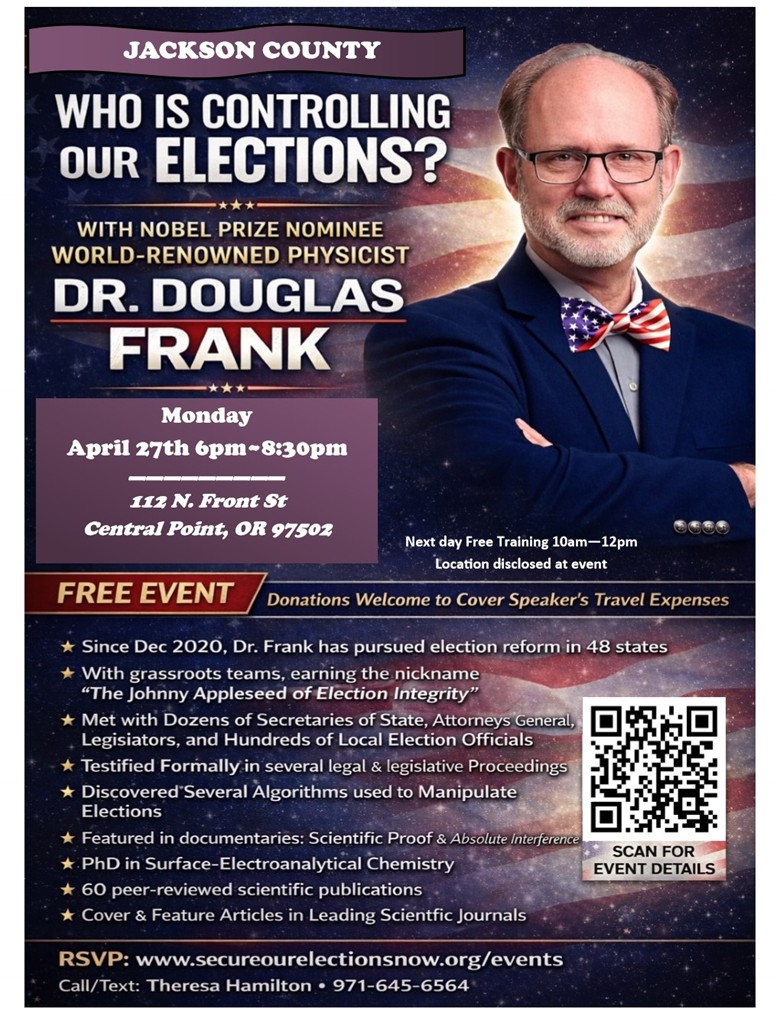
7:35 Dr. Douglas Frank www.secureourelectionsnow.org
8:10 Dr. Dennis Powers – www.DennisPowersBooks.com with today’s Where Past Meets Present
Mattie’s Nugget–and the Currency of Gold
By Dennis Powers
Throughout the country—and especially in Northern California and Southern Oregon—gold nuggets, bars, and even dust were used as currency until the 1930s. During the Great Depression, President Roosevelt decreed that the private ownership and use of gold as a currency to be illegal. Before then, gold was used to pay debts and anyone, whether a resident or not, could buy gold nuggets at any local bank, from Crescent City to Ashland.
In 1859, a small, nervous Irishman—one Mattie Collins—was working through the tailings around Althouse Creek in Josephine County’s Illinois Valley. Althouse Creek winds its way from the Siskiyou Mountains and flows over fifteen miles into the Illinois River. The area had been a fine place for placer gold discoveries. Although the great finds were largely over, Mattie was ever hopeful. On one of the tributaries, he looked up the bank and spotted a large stump with exposed roots. Hoping he might find something, he began pulling out rocks—and came across a huge nugget.
It weighed 17 pounds, the largest gold nugget reportedly discovered in Southern Oregon. Terrified that someone would rob him, or con him, if they heard about his good fortune, Mattie hired a fellow Irishman by the name of Dorsey to help him bring the nugget to a San Francisco bank. Collins and Dorsey jumped at every noise or strange shadow; they checked every side trail to avoid an ambush. They were able to get to arrive safely in San Francisco, and he sold the nugget for $3,500, which would be worth $1,250,000 today. When word went out about his find, miners flooded into the area—but didn’t find anything close to this.
Mattie kept the money in the San Francisco bank and worked for wages, first in California, and then in Nevada, Idaho, and Montana. The frugal man deposited his earnings into the same bank. The years passed by and at age 65, however, Mattie Collins fell in love with a younger woman. She succeeded where everyone else had failed: skimming the money away and then leaving him. Collins died near penniless, despite his good fortune and years of hard work.
Although the great majority of prospectors never came close to Mattie’s good fortune, gold for all those years was a currency—and preferred. Banks weighed the gold nuggets, accepted them, and gave gold coins in return. The coins were in five-dollar, ten-dollar, and twenty-dollar denominations. One problem was that the five-dollar gold coin was nearly the size of and appearance of a penny. Mistakes were made when passing out a five-dollar gold coin as change for a penny, the loss not equal to ones chagrin when later discovering this.
Whether Gold Hill or Jacksonville, prospectors came to town and exchanged their gold or nuggets for whiskey, women, clothing, food, or whatever provisions that were needed. When they needed more money, the miners trudged back into the hills. Disdainful of banks, they carried or hid their nuggets. If big enough or armed, some held them in public, including one who would set his quart glass jar of gold nuggets on the counter when ordering his meal.
The ones who owned the general stores and sold provisions to the miners were usually the ones who became prosperous. One local prospector, Lester Foley, wrote in 1931: “After seventeen years, I’m a little weary, hungry. I’m reduced to Spartan austerity. Have a depressed feeling. Am on a diet of beans. After 17 years, my pocket averaged $2.30 a year, excluding expenses–but included frost-bite, fly-bite, and rattlesnake bite, with bleeding fingers, an aching back, a frosted lung, and pain.”
With the quantitative easing seen and enormous U.S. and worldwide fiscal deficits, we might need to head back to those times.
Sources: Kerby Jackson, “OregonGold.Net: Great Gobs of Gold Abound in Southern Oregon,” at his website; Dennis M. Powers, Gold Hill: Images of America, Arcadia Publishing: Charleston, South Carolina, 2010, pp. 7-8, 21, et al; Dennis Powers, Where Past Meets Present, Hellgate Press: Ashland, Oregon, 2017, “Mattie’s Nugget and the Currency of Gold,” pp. 45-47.
8:45 Open for Business – Kelly Bales with Futurity First in Medford.
Turning 65 is a big milestone. And with it comes one of the most important decisions you’ll make — choosing the right Medicare coverage.
A free Medicare educational workshop — designed to walk you through your options clearly, so you can make the best choice for your health and your budget. At Futurity First, we’re independent advisors. That means no loyalty to insurance companies
Join them Tuesday, April 21st at Central Point Parks and Recreation, 235 South Haskell Street in Central Point — or Thursday, April 23rd at the Financial Learning Center, 516 Crater Lake Avenue in Medford. Both classes begin at 5:30.
Seating is limited, so sign up today at medicare-made-for-you-dot-org. That’s medicare-made-for-you-dot-O-R-G. Futurity First. On Crater Lake Avenue in Medford — putting your needs first.